Personalized Eye Care in Houston: The Smarter Questions
Personalized eye care in Houston begins with a question a standard vision chart cannot answer: what is making it harder for this person to see…

Personalized eye care in Houston begins with a question a standard vision chart cannot answer: what is making it harder for this person to see comfortably in daily life? Two patients may read the same line of letters yet have very different concerns. One struggles with dry eyes at a computer, while another wants contact lenses that remain comfortable through the afternoon.
The shift toward more individualized care is changing the conversation in the exam room. A prescription still matters, but so do symptoms, eye health, work habits, age, and the tasks a patient wants to do. The useful innovation is not simply having more options. It is knowing which option fits the problem.
It is easy to arrive at an appointment with a solution already in mind: stronger glasses, different contacts, or another bottle of eye drops. A better starting point is to describe what happens and when. Does vision blur after sustained reading? Do the eyes feel gritty late in the day? Is one lens less comfortable than the other?
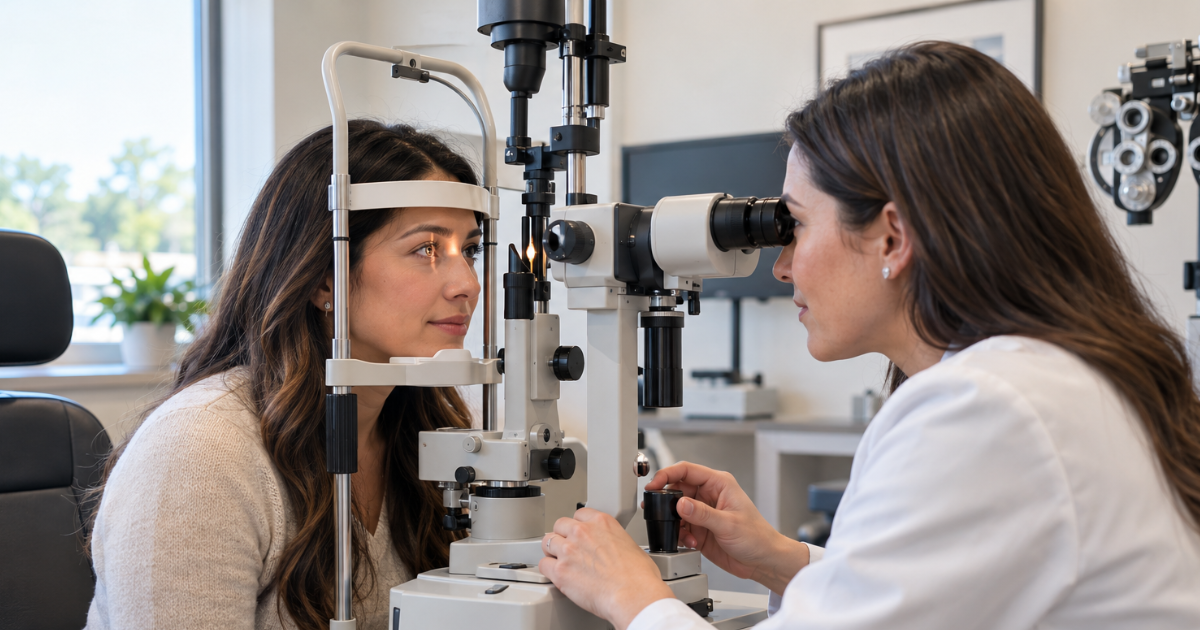
A comprehensive examination creates a foundation for those decisions. The American Optometric Association describes the range of tests an eye doctor may use to evaluate vision and eye health. The doctor can then decide whether the concern relates to a prescription, the eye’s surface, contact lens fit, or something that needs further assessment.
Before a visit, patients can make a short record of their symptoms:
These details make a more useful starting point than the broad statement, “My eyes are tired.”
Dry eye sounds like one condition with one obvious fix. In practice, symptoms can have different contributing factors. Tears may be insufficient, evaporate too quickly, or fail to keep the eye’s surface comfortable. Environment, medications, and contact lens wear may also enter the discussion.
The National Eye Institute explains how the tear film works: blinking spreads a thin layer of tears over the cornea. If that film does not function well, comfort and visual clarity can fluctuate. A person may even describe intermittent blur rather than saying their eyes feel dry.
Assessment helps narrow the possibilities. According to the National Eye Institute’s dry eye testing guide, an eye doctor may evaluate tear production and how long the tear film remains stable. The results, together with symptoms and history, can guide the next step.
For people who work at a screen, it helps to describe the work setup and when discomfort appears. Research reviewing digital screen use and dry eye discusses symptoms such as dryness, burning, and fluctuating vision, along with the role of blinking. Screen habits may be relevant, but they should not be treated as an automatic diagnosis. Persistent discomfort deserves an examination.
A contact lens must do more than provide clear vision on an eye chart. It needs to fit the eye and suit the wearer’s routine. Someone who wears lenses for occasional sports may have different priorities from someone who uses them throughout a long workday.
Tell the doctor if lenses feel fine in the morning but uncomfortable by evening, if vision changes while wearing them, or if handling them is difficult. Those observations can prompt a conversation about fit, lens type, wearing habits, or eye surface health. Specialty lenses may be considered for certain needs, but suitability depends on an individual evaluation. The National Eye Institute describes scleral lenses as one specialized design that rests on the white part of the eye rather than directly on the cornea.
Even a well-fitted lens requires proper care. The Centers for Disease Control and Prevention advises keeping water away from contact lenses and removing them before showering or swimming. Ask for instructions specific to your prescribed lenses, and follow the replacement and cleaning schedule given by your eye care team.
For a child whose nearsightedness is changing, today’s glasses prescription is only one piece of information. An eye doctor may also review how vision has changed over time and discuss whether myopia management is appropriate. The goal of that conversation is different from simply making distant objects clear today.
The National Eye Institute’s overview of myopia explains what nearsightedness is and why higher levels can carry additional eye health risks. Its reporting on research into multifocal contact lenses illustrates how options for managing progression have developed.
Parents can bring previous prescriptions to an appointment and ask how quickly the child’s vision has changed. They can also discuss the child’s ability to handle lenses, follow care instructions, and attend recommended follow-up visits. The appropriate plan depends on the child, rather than on a single headline about a new treatment.
A practice offering eye care, optical services, and hearing care can give patients several ways to address everyday concerns. It is still important to match each concern to the right evaluation. Trouble following conversations, for example, calls for a hearing discussion rather than an assumption that vision is the cause. The National Institute on Deafness and Other Communication Disorders lists signs that may warrant a hearing evaluation.
This approach applies to new technology as well. A device or specialized lens is useful when its purpose, expected benefit, limitations, and follow-up needs are clear to the patient. Good questions include: What finding led to this recommendation? What alternatives are available? How will we know whether it is helping?
The Lantern Lane office of Pupila Family Eye & Ear Care is at 12512 Memorial Drive, Suite A, in Houston. Its location page lists eye exams, pediatric care, myopia management, dry eye services, optical options, and hearing care. Patients interested in a particular concern can review the practice’s dry eye service information or discuss the appropriate type of appointment with the office.
A personalized plan should make sense after the visit, too. Before leaving, ask your eye care professional to explain:
Eye care is becoming more adaptable because clinicians can evaluate different problems and consider a wider range of responses. The patient’s role remains straightforward: describe the real-world difficulty, ask why an option is being recommended, and participate in a plan that can be reassessed as needs change.